 Beautiful Libraries
4/4/09
Kitsch causes two tears to flow in quick succession. The first tear says: How nice to see children running on the grass!
The second tear says: How nice to be moved, together with all mankind, by children running on the grass!
It is the second tear that makes kitsch kitsch.
The brotherhood of man on earth will be possible only on a base of kitsch.
-Milan Kundera, The Unbearable Lightness of Being
The second tear says: How nice to be moved, together with all mankind, by children running on the grass!
It is the second tear that makes kitsch kitsch.
The brotherhood of man on earth will be possible only on a base of kitsch.
-Milan Kundera, The Unbearable Lightness of Being

4/3/09
One always writes in order to confess, to ask forgiveness; no doubt one always teaches, also, in order to ask forgiveness.
-Jacques Derrida
[via some kid]
-Jacques Derrida
[via some kid]
3/31/09
Just Now
a ladybug, its carapace blown open
so a translucent trace of orange gleams
from its body, has ascended link by link
the smudgy silver curve of my watch band.
It must have helicoptered past the sill
while I was slumped here squinting in the paper
at the ashen packaging another bombing's
made of a minivan. Made available
in the photo like the homeless in a poem.
The pain is far away. But then for moments
utterly clear: molten metal guttering
down from the Milky Way to fall on us.
And sometimes, God, it lands with all its will.
My spluttered prayer for it to hold its distance:
how ludicrous to blurt it from this comfort.
Still it impels itself from me. Please stay
away from me. Please stay away from this
insectile soul who only weeks ago
was wind and shit and jasmine leaves and rain.
-Peter Campion
so a translucent trace of orange gleams
from its body, has ascended link by link
the smudgy silver curve of my watch band.
It must have helicoptered past the sill
while I was slumped here squinting in the paper
at the ashen packaging another bombing's
made of a minivan. Made available
in the photo like the homeless in a poem.
The pain is far away. But then for moments
utterly clear: molten metal guttering
down from the Milky Way to fall on us.
And sometimes, God, it lands with all its will.
My spluttered prayer for it to hold its distance:
how ludicrous to blurt it from this comfort.
Still it impels itself from me. Please stay
away from me. Please stay away from this
insectile soul who only weeks ago
was wind and shit and jasmine leaves and rain.
-Peter Campion
3/29/09
 “This photo was taken by photographer Jack Bradley and depicts the exact moment this boy, Harold Whittles, hears for the very first time ever. The doctor treating him has just placed an earpiece in his left ear. Date unknown."
-ScienceBuzz
[via it loved to happen]
3/21/09
There is only this now. It does not come from anywhere; it is not going anywhere. It is not permanent, but it is not impermanent. Though moving, it is always still. When we try to catch it, it seems to run away, and yet it is always here and there is no escape from it... When Fa-ch'ang was dying, a squirrel screeched on the roof. "It's just this," he said,"and nothing else."
-Alan Watts, The Way of Zen
-Alan Watts, The Way of Zen
"In walking, just walk. In sitting, just sit. Above all, don't wobble." In other words, the mind cannot act without giving up the impossible attempt to control itself beyond a certain point... This is why Zen often seems to take the side of action as against reflection, and why it describes itself as "no-mind" (wu-hsin) or "no-thought" (wu-nien), and why the masters demonstrate Zen by giving instantaneous and unpremeditated answers to questions. When Yün-men was asked for the ultimate secret of Buddhism, he replied, "Dumpling!"
-Alan Watts, The Way of Zen
-Alan Watts, The Way of Zen
Paradoxical as it may seem, the purposeful life has no content, no point. It hurries on and on, and misses everything. Not hurrying, the purposeless life misses nothing, for it is only when there is no goal and no rush that the human senses are fully open to receive the world... the Taoist mentality makes, or forces, nothing but "grows" everything. When human reason is seen to be an expression of the same spontaneous balance of yang and yin as the natural universe, man's action upon his environment is not felt as a conflict, an action from outside. Thus the difference between forcing and growing cannot be expressed in terms of specific directions as to what should or should not be done, for the difference lies primarily in the quality and feeling of the action. The difficulty of describing these things for Western ears is that people in a hurry cannot feel.
-Alan Watts, The Way of Zen
-Alan Watts, The Way of Zen
3/20/09
3/18/09
Meditation at Lagunitas
All the new thinking is about loss.
In this it resembles all the old thinking.
The idea, for example, that each particular erases
the luminous clarity of a general idea. That the clown-
faced woodpecker probing the dead sculpted trunk
of that black birch is, by his presence,
some tragic falling off from a first world
of undivided light. Or the other notion that,
because there is in this world no one thing
to which the bramble of blackberry corresponds,
a word is elegy to what it signifies.
We talked about it late last night and in the voice
of my friend, there was a thin wire of grief, a tone
almost querulous. After a while I understood that,
talking this way, everything dissolves: justice,
pine, hair, woman, you and I. There was a woman
I made love to and I remembered how, holding
her small shoulders in my hands sometimes,
I felt a violent wonder at her presence
like a thirst for salt, for my childhood river
with its island willows, silly music from the pleasure boat,
muddy places where we caught the little orange-silver fish
called pumpkinseed. It hardly had to do with her.
Longing, we say, because desire is full
of endless distances. I must have been the same to her.
But I remember so much, the way her hands dismantled bread,
the thing her father said that hurt her, what
she dreamed. There are moments when the body is as numinous
as words, days that are the good flesh continuing.
Such tenderness, those afternoons and evenings,
saying blackberry, blackberry, blackberry.
-Robert Hass
[Foster said this was either the most famous, most representative, or most important lyric poem of the last quarter century. Maybe all three, I can't remember.]
In this it resembles all the old thinking.
The idea, for example, that each particular erases
the luminous clarity of a general idea. That the clown-
faced woodpecker probing the dead sculpted trunk
of that black birch is, by his presence,
some tragic falling off from a first world
of undivided light. Or the other notion that,
because there is in this world no one thing
to which the bramble of blackberry corresponds,
a word is elegy to what it signifies.
We talked about it late last night and in the voice
of my friend, there was a thin wire of grief, a tone
almost querulous. After a while I understood that,
talking this way, everything dissolves: justice,
pine, hair, woman, you and I. There was a woman
I made love to and I remembered how, holding
her small shoulders in my hands sometimes,
I felt a violent wonder at her presence
like a thirst for salt, for my childhood river
with its island willows, silly music from the pleasure boat,
muddy places where we caught the little orange-silver fish
called pumpkinseed. It hardly had to do with her.
Longing, we say, because desire is full
of endless distances. I must have been the same to her.
But I remember so much, the way her hands dismantled bread,
the thing her father said that hurt her, what
she dreamed. There are moments when the body is as numinous
as words, days that are the good flesh continuing.
Such tenderness, those afternoons and evenings,
saying blackberry, blackberry, blackberry.
-Robert Hass
[Foster said this was either the most famous, most representative, or most important lyric poem of the last quarter century. Maybe all three, I can't remember.]
3/17/09
Many years later the older Updike, now giving up on alcohol, coffee and salt, put into the mouth of that God the words of Frederick the Great excoriating his battle-shy soldiers -- "Dogs, would you live forever?" But all the life-enhancing substances were set aside, and writing became Updike's "sole remaining vice. It is an addiction, an illusory release, a presumptuous taming of reality." In the mornings, he could write "breezily" of what he could not contemplate in the dark without "turning in panic to God". The plain facts of life were "unbearably heavy, weighted as they are with our personal death. Writing, in making the world light -- in codifying, distorting, prettifying, verbalising it -- approaches blasphemy."
-Ian McEwan
[via I forget who]
-Ian McEwan
[via I forget who]
With a frequency over a million, billion times deeper than the limits of human hearing, it is the deepest note ever detected from an object in the Universe.
'Black hole hums B flat'
'Black hole hums B flat'
3/16/09
For 25 years I have read criticisms of my stories and I don't remember a single remark of any value or one word of valuable advice. Only once [a critic] said something which made an impression on me - he said I would die in a ditch, drunk.
-Anton Chekhov
-Anton Chekhov
3/14/09
Chekhov said: "Every person lives his real, most interesting life under the cover of secrecy." By this I take him to mean that other people are fundamentally opaque, mysterious - even people you know very well, your wife or husband, your family. Janet Malcolm, who has written a profound and insightful book on Chekhov (Reading Chekhov), says that "We never see people in life as clearly as we see the people in novels, stories and plays; there is a veil between ourselves and even our closest intimates, blurring us to each other." This, it seems to me, is the great and lasting allure of all fiction: if we want to know what other people are like we turn to the novel or the short story. In no other art form can we take up residence in other people's minds so effortlessly. Chekhov tells us a great deal about his characters but, however, resists full exposure: there always remains something "blurry", something secret about them. This is part of his genius: this is what makes his stories seem so real.
-William Boyd, 'A Chekhov Lexicon'
[via Anecdotal Evidence]
-William Boyd, 'A Chekhov Lexicon'
[via Anecdotal Evidence]
3/13/09
It is the word pejorative that hurts.
My old boat goes round on a crutch
And doesn't get under way.
-Wallace Stevens
My old boat goes round on a crutch
And doesn't get under way.
-Wallace Stevens
Sheets of paper covered with words pile up in archives sadder than cemeteries, because no one ever visits them, not even on All Souls' Day. Culture is perishing in overproduction, in an avalanche of words, in the madness of quantity. That's why one banned book in your former country means infinitely more than the billions of words spewed out by our universities.
-Milan Kundera, The Unbearable Lightness of Being
-Milan Kundera, The Unbearable Lightness of Being
7

Dear stranger
extant in memory by the blue Juniata,
these letters
across space I guess
will be all we will know of one another.

So little of what one is threads itself through the eye
of empty space.

Never mind.
The self is the least of it.
Let our scars fall in love.

-Galway Kinnell, 'The Book of Nightmares'
3/12/09
A recent long-term study conducted in Scandinavia sought to discover which activities related to a healthy and happy later life. Three stood out: camping, dancing and singing.
-Brian Eno
-Brian Eno
3/10/09


The late Richard Rorty saw irony as a state of mind intimately connected with the postmodern worldview—a withdrawal from judgment that nevertheless aims at a kind of consensus, a shared agreement not to judge. The ironic temperament, however, is better understood as a virtue—a disposition aimed at a kind of practical fulfillment and moral success. Venturing a definition of this virtue, I would describe it as a habit of acknowledging the otherness of everything, including oneself. However convinced you are of the rightness of your actions and the truth of your views, look on them as the actions and the views of someone else and rephrase them accordingly. So defined, irony is quite distinct from sarcasm: it is a mode of acceptance rather than a mode of rejection. It also points both ways: through irony, I learn to accept both the other on whom I turn my gaze, and also myself, the one who is gazing. Pace Rorty, irony is not free from judgment: it simply recognizes that the one who judges is also judged, and judged by himself.
3/8/09

3/1/09
This stranger-poet-survivor carries "a book of myths" in which her/his "names do not appear." These are the old myths of patriarchy, the myths that split male and female irreconcilably into two warring factions, the myths that perpetuate the battle between the sexes. Implicit in Rich's image of the androgyne is the idea that we must write new myths, create new definitions of humanity which will not glorify this angry chasm but heal it. Rich's visionary androgyne reminds me of Virginia Woolf’s assertion that the great artist must be mentally bisexual. But Rich takes this idea even further: it is not only the artist who must make the emphatic leap beyond gender, but any of us who would try to save the world from destruction.
-Erica Jong, on Adrienne Rich's 'Diving into the Wreck'
-Erica Jong, on Adrienne Rich's 'Diving into the Wreck'
2/25/09
Poetry is a superior amusement: I do not mean an amusement for superior people. I call it an amusement, an amusement pour distraire les honnêtes gens, not because that is a true definition, but because if you call it anything else you are likely to call it something still more false. If we think of the nature of amusement, then poetry is not amusing; but if we think of anything else that poetry may seem to be, we are led into far greater difficulties.
-T.S. Eliot
[quoted]
-T.S. Eliot
[quoted]
2/18/09
Crying Angel
Nothing prepared me for heaven.
Its scaffolds -- street after street --
halls leading to halls,
rooms papered with distance
Its scaffolds -- street after street --
halls leading to halls,
rooms papered with distance
as if heaven were only perspective,
a vanishing point drawing us
until we vanished. And if
I am crying, it's for small things:
staplers, bowls, gloves, spoons
on their pedestals, their ideal forms
lost at the ends of corridors --
for Music in its winged box,
Math's fulcrum and see-saw,
Geography's colored pins, its there, there.
How did we ever come to think
the single world was precious,
the model for us to love --
one town, one house, one sky,
one woman, the mole on her back --
when it is the universe, its gaps,
the mileage between its outposts,
God loves and is his image?
They weren't lies after all, the stories
where we are transmuted into stars
or into water lost in the infinity
of itself. Who could have imagined
God's need for distance,
his hurling us away to be near him?
2/17/09
The most important thing a beginning writer may have going for her is her bone-deep impulse to defend a self that at the time might not look all that worth getting worked up about.
-Kay Ryan
-Kay Ryan
even if your preferred mode is fragment, you need syntax to love. Still, there is a "leaking" when we try to put things together. As a bowl starts out being a bowl, the not- bowlness drains out of it. Later, form is not something we remember doing, like being born.
-Brenda Hillman, quoted by Mark Doty at AWP 2009
Now here I am, going to AWP. How am I going to remember: these people are THE SPAWN OF THE DEVIL? They will seem like individuals, not deadly white threads of the great creative writing fungus...
I don’t want to be connected to poetry in an easy, fellowshipping way, but I do want to be connected in a way that will earn me the respect of the dead.
-Kay Ryan, 'I Go to AWP,' and you should have too!
I don’t want to be connected to poetry in an easy, fellowshipping way, but I do want to be connected in a way that will earn me the respect of the dead.
-Kay Ryan, 'I Go to AWP,' and you should have too!
The Annihilation of Nothing
Nothing remained: Nothing, the wanton name
That nightly I rehearsed till led away
To a dark sleep, or sleep that held one dream.
That nightly I rehearsed till led away
To a dark sleep, or sleep that held one dream.
In this a huge contagious absence lay,
More space than space, over the cloud and slime,
Defined but by the encroachments of its sway.
Stripped to indifference at the turns of time,
Whose end I knew, I woke without desire,
And welcomed zero as a paradigm.
But now it breaks - images burst with fire
Into the quiet sphere where I have bided,
Showing the landscape holding yet entire:
The power that I envisaged, that presided
Ultimate in its abstract devastations,
Is merely change, the atoms it divided
Complete, in ignorance, new combinations.
Only an infinite finitude I see
In those peculiar lovely variations.
It is despair that nothing cannot be
Flares in the mind and leaves a smoky mark
Of dread.
Look upward. Neither firm nor free,
Purposeless matter hovers in the dark.
-Thom Gunn
2/9/09
Children as young as three readily attribute design and purpose to inanimate objects. When Deborah Kelemen of the University of Arizona in Tucson asked 7 and 8-year-old children questions about inanimate objects and animals, she found that most believed they were created for a specific purpose. Pointy rocks are there for animals to scratch themselves on. Birds exist "to make nice music", while rivers exist so boats have something to float on. "It was extraordinary to hear children saying that things like mountains and clouds were 'for' a purpose and appearing highly resistant to any counter-suggestion," says Kelemen.
-Michael Brooks, in 'Born Believer: How Your Brain Creates God'
[via morethan95theses]
-Michael Brooks, in 'Born Believer: How Your Brain Creates God'
[via morethan95theses]
2/8/09
2/7/09
Awesome thing about Twitter #1,729: No one asks you to post twenty-five random boring facts about yourself.
-ayjay
2/4/09
Those To Come
Eyeless in the morning sun you were
pale and mild, a modern girl
taken with thought, still prone to care
makin tea in your underwear
you went out in the yard to find
something to eat and clear your mind
something bad inside me went away
quaking leaves and broken light
shifting skin the coming night
the bearers of all good things arrive
climb inside us, twist and cry
a kiss on your molten eyes
myriad lives like blades of grass
yet to be realized, bow as they pass
they are cold,
still,
waiting in the ether,
to form,
feel,
kill,
propagate,
only to die
(x2)
dissolve
magically,
absurdly,
they'll end,
leave,
dissipate,
coldly
and strangely
return
-The Shins
pale and mild, a modern girl
taken with thought, still prone to care
makin tea in your underwear
you went out in the yard to find
something to eat and clear your mind
something bad inside me went away
quaking leaves and broken light
shifting skin the coming night
the bearers of all good things arrive
climb inside us, twist and cry
a kiss on your molten eyes
myriad lives like blades of grass
yet to be realized, bow as they pass
they are cold,
still,
waiting in the ether,
to form,
feel,
kill,
propagate,
only to die
(x2)
dissolve
magically,
absurdly,
they'll end,
leave,
dissipate,
coldly
and strangely
return
-The Shins
2/1/09
1/29/09
1/26/09
1/25/09
Our metaphors go on ahead of us, they know before we do. And thank goodness for that, for if I were dependent on other ways of coming to knowledge I think I'd be a very slow study. I need something to serve as a container for emotion and idea, a vessel that can hold what's too slippery or charged or difficult to touch. Will doesn't have much to do with this; I can't choose what's going to serve as a compelling image for me. But I've learned to trust that part of my imagination that gropes forward, feeling its way toward what it needs; to watch for the signs of fascination, the sense of compelled attention (Look at me, something seems to say, closely) that indicates that there's something I need to attend to. Sometimes it seems to me as if metaphor were the advance guard of the mind; something in us reaches out, into the landscape in front of us, looking for the right vessel, the right vehicle, for whatever will serve.
-Mark Doty, Reflects on His Poem 'A Display of Mackerel'
-Mark Doty, Reflects on His Poem 'A Display of Mackerel'
1/24/09
1/17/09
About love and how to survive - not to make a living - but how to survive whole in a world where we are all of us, in some measure, victims of something. Each one of us in some way at some moment a victim and in no position to do anything about it. Some child is always left unpicked up at some moment. In a world like that, how does one remain whole - is it just impossible to do that?
-Toni Morrison, in Conversations
-Toni Morrison, in Conversations
1/14/09
Origins
I'm from touch football in parking lots and street corner Romeos
I'm from half-brothers and three-quarter nelsons
I'm from watered-down blue blood and finger-painting on subway walls
I'm from tongue kisses in stairwells and tequila sunsets in the closet
I'm from stealing the coins out of other people's wishing wells
I'm from jordache jeans and pick-up games in the twilight
I'm from Italian girls wearing murmurs I oh so badly wanted to speak
I'm from sidestepped obligations and nomadic fingertips
I'm from listerine in alleyways and whiskers in the vaseline
I'm from unreliable narrators and abandoned buildings
I'm from don't cross 24th Street because of the Irish and don't cross South Street because of the blacks
I'm from the merry-go-round where white guys in cars slow down after midnight to take a visual bite out of my twelve-year-old ass
I'm from fuck you when my friends are around, and please stop looking at me, please stop looking at me, please stop looking at me, when I'm alone
I'm from sucker punches and a mouthful of blood spit in my face
I'm from a nightgown breathing at the bottom of a staircase
I'm from I wished you died in that hospital
I'm from exit plans that involve shotguns
I'm from you gonna front like the hard guy, you better back that shit up
-Jeffrey McDaniel, in The Endarkenment
I'm from half-brothers and three-quarter nelsons
I'm from watered-down blue blood and finger-painting on subway walls
I'm from tongue kisses in stairwells and tequila sunsets in the closet
I'm from stealing the coins out of other people's wishing wells
I'm from jordache jeans and pick-up games in the twilight
I'm from Italian girls wearing murmurs I oh so badly wanted to speak
I'm from sidestepped obligations and nomadic fingertips
I'm from listerine in alleyways and whiskers in the vaseline
I'm from unreliable narrators and abandoned buildings
I'm from don't cross 24th Street because of the Irish and don't cross South Street because of the blacks
I'm from the merry-go-round where white guys in cars slow down after midnight to take a visual bite out of my twelve-year-old ass
I'm from fuck you when my friends are around, and please stop looking at me, please stop looking at me, please stop looking at me, when I'm alone
I'm from sucker punches and a mouthful of blood spit in my face
I'm from a nightgown breathing at the bottom of a staircase
I'm from I wished you died in that hospital
I'm from exit plans that involve shotguns
I'm from you gonna front like the hard guy, you better back that shit up
-Jeffrey McDaniel, in The Endarkenment
1/10/09

1/7/09
Planetarium
Thinking of Caroline Herschel (1750-1848),
astronomer, sister of William; and others.

A woman in the shape of a monster
a monster in the shape of a woman
the skies are full of them

a woman 'in the snow
among the Clocks and instruments
or measuring the ground with poles'

in her 98 years to discover
8 comets

She whom the moon ruled
like us
levitating into the night sky
riding the polished lenses

Galaxies of women, there
doing penance for impetuousness
ribs chilled


in those spaces          of the mind

An eye,
'virile, precise and absolutely certain'
from the mad webs of Uranusborg
encountering the NOVA
every impulse of light exploding
from the core
as life flies out of us

Tycho whispering at last
'Let me not seem to have lived in vain'

What we see, we see
and seeing is changing

the light that shrivels a mountain
and leaves a man alive

Heartbeat of the pulsar
heart sweating through my body

The radio impulse
pouring in from Taurus

I am bombarded yet I stand
I have been standing all my life in the
direct path of a battery of signals
the most accurately transmitted most
untranslatable language in the universe
I am a galactic cloud so deep so invo-
luted that a light wave could take 15
years to travel through me And has
taken I am an instrument in the shape
of a woman trying to translate pulsations
into images for the relief of the body
and the reconstruction of the mind.

-Adrienne Rich
… Many of those who seek help in workshops in order get published have a dream, I think, not so much of devoting the most intense part of their lives to the hard, lonely. Glorious, transcendent work-play of writing poetry, but of appearing before the world as a poet. It is a dream of individual freedom, an unexamined, perhaps even unconscious need in a country where even the individualizing first name of a human being has been reduced to the uniformed and meaningless: "My name is Jean; I am your waitress for the evening." It does not in any way resemble the hippie rebellion in which youth divided itself from age by dressing alike, acting, talking, wearing their hair, eating, living alike. The point of this dream is the expression of freedom and uniqueness of a self. Need I say that, though some few professional poets have felt free to express outwardly their quirky selfness, it is the strong inner sense of self, usually protected from the public eye, saved from and dedicated to the poems, that is characteristic of most successful publishing poets/ Most of them are happy to be indistinguishable in public, leading quiet, domestic lives. The private aspects of the wild and the unique are saved for the poems. Iconoclasm is saved, hoarded, for language – for forms on the page.
-Mona Van Duyn, "Matters of Poetry"[via Fort of Sand]
12/29/08
Brown is unusual in contemporary poetry for her willingness to be thought ill of. In fact, it's significant that ugly-truth-tellers are much more common in our fiction than our poetry. Much of our mainstream poetry is confined by an ethic of sincerity and the unstated wish to be admired (if not admired, liked; if not liked, sympathized with). American poetry still largely believes, as romantics have for a few hundred years, that a poem is straightforward autobiographical testimony to, among other things, the decency of the speaker. And, for all the freedom and "opening up" engendered by Confessionalism, to be uninhibitedly mean, we all know, is itself prohibited. Welcome to Poetry City: Hurt someone's feelings: Go to jail.
-Tony Hoagland, 'Negative Capability: How to Talk Mean and Influence People'
-Tony Hoagland, 'Negative Capability: How to Talk Mean and Influence People'
We fall in love, we drink hard, we run to and fro upon the earth like frightened sheep, and now you are to ask yourself if, when all is done, you would not have been better to sit by the fire at home, and be happy thinking.
-Robert Louis Stevenson
[via 3quarks and ayjay]
-Robert Louis Stevenson
[via 3quarks and ayjay]


12/20/08
If you're studying geology, which is all facts, as soon as you get out of school you forget it all, but philosophy you remember just enough to screw you up for the rest of your life.
-Steve Martin
-Steve Martin
Bad poetry always suffers from the same defects: synthetic hallucination and artifice. Invention is not poetry.... Poetry is vision, the pure act of sensual communion and contemplation.
-Kenneth Rexroth [via]
-Kenneth Rexroth [via]
12/14/08
20
I know the sound of the ecstatic flute,
but I don't know whose flute it is.
A lamp burns and has neither wick nor oil.
A lily pad blossoms and is not attached to the bottom!
When one flower opens, ordinarily dozens open.
The moon bird's head is filled with nothing but
thoughts of the moon,
and when the next rain will come is all that the rain bird thinks of.
Who is it we spend our entire life loving?
-Kabir, trans. Robert Bly
I know the sound of the ecstatic flute,
but I don't know whose flute it is.
A lamp burns and has neither wick nor oil.
A lily pad blossoms and is not attached to the bottom!
When one flower opens, ordinarily dozens open.
The moon bird's head is filled with nothing but
thoughts of the moon,
and when the next rain will come is all that the rain bird thinks of.
Who is it we spend our entire life loving?
-Kabir, trans. Robert Bly
12/8/08
Edward Hopper and the House by the Railroad (1925)
 Out here in the exact middle of the day,
This strange, gawky house has the expression
Of someone being stared at, someone holding
His breath underwater, hushed and expectant;
This house is ashamed of itself, ashamed
Of its fantastic mansard rooftop
And its pseudo-Gothic porch, ashamed
of its shoulders and large, awkward hands.
But the man behind the easel is relentless.
He is as brutal as sunlight, and believes
The house must have done something horrible
To the people who once lived here
Because now it is so desperately empty,
It must have done something to the sky
Because the sky, too, is utterly vacant
And devoid of meaning. There are no
Trees or shrubs anywhere--the house
Must have done something against the earth.
All that is present is a single pair of tracks
Straightening into the distance. No trains pass.
Now the stranger returns to this place daily
Until the house begins to suspect
That the man, too, is desolate, desolate
And even ashamed. Soon the house starts
To stare frankly at the man. And somehow
The empty white canvas slowly takes on
The expression of someone who is unnerved,
Someone holding his breath underwater.
And then one day the man simply disappears.
He is a last afternoon shadow moving
Across the tracks, making its way
Through the vast, darkening fields.
This man will paint other abandoned mansions,
And faded cafeteria windows, and poorly lettered
Storefronts on the edges of small towns.
Always they will have this same expression,
The utterly naked look of someone
Being stared at, someone American and gawky.
Someone who is about to be left alone
Again, and can no longer stand it.
-Edward Hirsch
12/1/08
Ideal Audience
Not scattered legions,
not a dozen from
a single region
for whom accent
matters, not a seven-
member coven,
not five shirttail
cousins; just
one free citizen -
maybe not alive
now even - who
will know with
exquisite gloom
that only we two
ever found this room.
-Kay Ryan
not a dozen from
a single region
for whom accent
matters, not a seven-
member coven,
not five shirttail
cousins; just
one free citizen -
maybe not alive
now even - who
will know with
exquisite gloom
that only we two
ever found this room.
-Kay Ryan
11/26/08
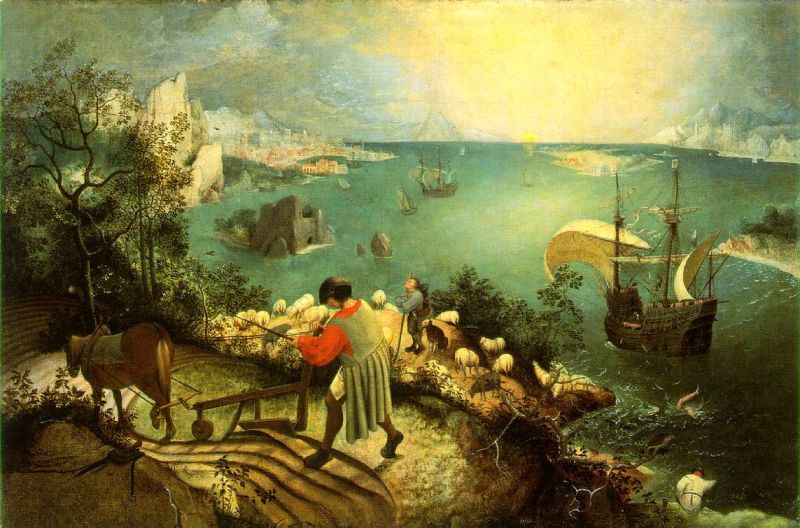 Landscape with the Fall of Icarus" c. 1554-55, oil on canvas
by Pieter Bruegel the Elder, Netherlands (1525-1569)
Compare with:
 -Ji Lee at Wooster Collective
A David Foster Wallace Collection Post!
The same obsessive studying that helped me come alive also kept me dead: it was a way to hide from people, to try to earn—through ‘achievement’ or whatever—permission to be at Amherst that I was too self-centered to realize I’d already received when they accepted me... It took years after I’d graduated from Amherst to realize that people were actually far more complicated and interesting than books, that almost everyone else suffered the same secret fears and inadequacies as I, and that feeling alone and inferior was actually the great valent bond between us all.
-in 'Brief Interview with a Five Draft Man'
Michael Pietsche, the editor... said it seemed to him like a piece of glass that had been dropped from a great height. And that was the first time that anybody had ever conceptualized what was to me just a certain structural representation of the way the world kind of operated on my nerve endings, which was as a bunch of discrete random bits, but which contained within them, not always all that blatantly, very interesting connections.
-in an interview with Michael Silverblatt discussing Infinite Jest, fractals and Sierpinski Gaskets
"If the book's about anything," he said, "it's about the question of why am I watching so much shit? It's not about the shit. It's about me: Why am I doing it? The original title was A Failed Entertainment, and the book is structured as an entertainment that doesn't work" — characters developing and scattering, chapters disordered — "because what entertainment ultimately leads to is 'Infinite Jest,' that's the star it's steering by."
-in 'The Lost Years and Last Days of David Foster Wallace'
When you exit these pages after that month of reading, you are a better person. It’s insane, but also hard to deny. Your brain is stronger because it’s been given a month-long workout, and more importantly, your heart is sturdier, for there has scarcely been written a more moving account of desperation, depression, addiction, generational stasis and yearning, or the obsession with human expectations, with artistic and athletic and intellectual possibility. The themes here are big, and the emotions (guarded as they are) are very real, and the cumulative effect of the book is, you could say, seismic. It would be very unlikely that you would find a reader who, after finishing the book, would shrug and say, “Eh.”
-Dave Eggers in the new foreword to Infinite Jest, where he also tries to answer the question: "Is it our duty to read Infinite Jest?"
-in 'Brief Interview with a Five Draft Man'
Michael Pietsche, the editor... said it seemed to him like a piece of glass that had been dropped from a great height. And that was the first time that anybody had ever conceptualized what was to me just a certain structural representation of the way the world kind of operated on my nerve endings, which was as a bunch of discrete random bits, but which contained within them, not always all that blatantly, very interesting connections.
-in an interview with Michael Silverblatt discussing Infinite Jest, fractals and Sierpinski Gaskets
"If the book's about anything," he said, "it's about the question of why am I watching so much shit? It's not about the shit. It's about me: Why am I doing it? The original title was A Failed Entertainment, and the book is structured as an entertainment that doesn't work" — characters developing and scattering, chapters disordered — "because what entertainment ultimately leads to is 'Infinite Jest,' that's the star it's steering by."
-in 'The Lost Years and Last Days of David Foster Wallace'
When you exit these pages after that month of reading, you are a better person. It’s insane, but also hard to deny. Your brain is stronger because it’s been given a month-long workout, and more importantly, your heart is sturdier, for there has scarcely been written a more moving account of desperation, depression, addiction, generational stasis and yearning, or the obsession with human expectations, with artistic and athletic and intellectual possibility. The themes here are big, and the emotions (guarded as they are) are very real, and the cumulative effect of the book is, you could say, seismic. It would be very unlikely that you would find a reader who, after finishing the book, would shrug and say, “Eh.”
-Dave Eggers in the new foreword to Infinite Jest, where he also tries to answer the question: "Is it our duty to read Infinite Jest?"
11/25/08
Why We Tell Stories
For Linda Foster
I
Because we used to have leaves
and on damp days
our muscles feel a tug,
painful now, from when roots
pulled us into the ground
and because our children believe
they can fly, an instinct retained
from when the bones in our arms
were shaped like zithers and broke
neatly under their feathers
and because before we had lungs
we knew how far it was to the bottom
as we floated open-eyed
like painted scarves through the scenery
of dreams, and because we awakened
and learned to speak
2
We sat by the fire in our caves,
and because we were poor, we made up a tale
about a treasure mountain
that would open only for us
and because we were always defeated,
we invented impossible riddles
only we could solve,
monsters only we could kill,
women who could love no one else
and because we had survived
sisters and brothers, daughters and sons,
we discovered bones that rose
from the dark earth and sang
as white birds in the trees
3
Because the story of our life
becomes our life
Because each of us tells
the same story
but tells it differently
and none of us tells it
the same way twice
Because grandmothers looking like spiders
want to enchant the children
and grandfathers need to convince us
what happened happened because of them
and though we listen only
haphazardly, with one ear,
we will begin our story
with the word and
-Lisel Mueller
I
Because we used to have leaves
and on damp days
our muscles feel a tug,
painful now, from when roots
pulled us into the ground
and because our children believe
they can fly, an instinct retained
from when the bones in our arms
were shaped like zithers and broke
neatly under their feathers
and because before we had lungs
we knew how far it was to the bottom
as we floated open-eyed
like painted scarves through the scenery
of dreams, and because we awakened
and learned to speak
2
We sat by the fire in our caves,
and because we were poor, we made up a tale
about a treasure mountain
that would open only for us
and because we were always defeated,
we invented impossible riddles
only we could solve,
monsters only we could kill,
women who could love no one else
and because we had survived
sisters and brothers, daughters and sons,
we discovered bones that rose
from the dark earth and sang
as white birds in the trees
3
Because the story of our life
becomes our life
Because each of us tells
the same story
but tells it differently
and none of us tells it
the same way twice
Because grandmothers looking like spiders
want to enchant the children
and grandfathers need to convince us
what happened happened because of them
and though we listen only
haphazardly, with one ear,
we will begin our story
with the word and
-Lisel Mueller
Bedtime Story
The moon lies on the river
like a drop of oil.
The children come to the banks to be healed
of their wounds and bruises.
The fathers who gave them their wounds and bruises
come to be healed of their rage.
The mothers grow lovely; their faces soften,
the birds in their throats awake.
They all stand hand in hand
and the trees around them,
forever on the verge
of becoming one of them,
stop shuddering and speak their first word.
But that is not the beginning.
It is the end of the story,
and before we come to the end,
the mothers and fathers and children
must find their way to the river,
separately, with no one to guide them.
That is the long, pitiless part,
and it will scare you.
-Lisel Mueller
[see also 'Reading the Brothers Grimm to Jenny']
like a drop of oil.
The children come to the banks to be healed
of their wounds and bruises.
The fathers who gave them their wounds and bruises
come to be healed of their rage.
The mothers grow lovely; their faces soften,
the birds in their throats awake.
They all stand hand in hand
and the trees around them,
forever on the verge
of becoming one of them,
stop shuddering and speak their first word.
But that is not the beginning.
It is the end of the story,
and before we come to the end,
the mothers and fathers and children
must find their way to the river,
separately, with no one to guide them.
That is the long, pitiless part,
and it will scare you.
-Lisel Mueller
[see also 'Reading the Brothers Grimm to Jenny']
Poetry is a superior amusement: I do not mean an amusement for superior people. I call it an amusement, an amusement pour distraire les honnêtes gens, not because that is a true definition, but because if you call it anything else you are likely to call it something still more false. If we think of the nature of amusement, then poetry is not amusing; but if we think of anything else that poetry may seem to be, we are led into far greater difficulties.
-T.S. Eliot
[quoted by Kay Ryan]
-T.S. Eliot
[quoted by Kay Ryan]

The Pure Fury
1
Stupor of knowledge lacking inwardness-
What book, O learned man, will set me right?
Once I read nothing through a fearful night,
For every meaning had grown meaningless.
Morning, I saw the world with second sight,
As if all things had died, and rose again.
I touched the stones, and they had my own skin.
-Theodore Roethke
Stupor of knowledge lacking inwardness-
What book, O learned man, will set me right?
Once I read nothing through a fearful night,
For every meaning had grown meaningless.
Morning, I saw the world with second sight,
As if all things had died, and rose again.
I touched the stones, and they had my own skin.
-Theodore Roethke
The Sententious Man
4
Though all's in motion, who is passing by?
The after-image never stays the same.
There was a thicket where I went to die,
And there I thrashed, my thighs and face aflame.
But my least motion changed into a song,
And all dimensions quivered to one thing.
-Theodore Roethke
Though all's in motion, who is passing by?
The after-image never stays the same.
There was a thicket where I went to die,
And there I thrashed, my thighs and face aflame.
But my least motion changed into a song,
And all dimensions quivered to one thing.
-Theodore Roethke
11/20/08
Stones taught me to fly
Love, it taught me to lie
Life, it taught me to die
So it's not hard to fall
When you float like a cannonball
-Damien Rice
Love, it taught me to lie
Life, it taught me to die
So it's not hard to fall
When you float like a cannonball
-Damien Rice
11/18/08
Rothko's Yellow

What I don't understand is the beauty.
The last attempts of the rain, my shoulders
aching from all afternoon with the ladders
and the hour with her. I watch the rainbow
until I have to focus so hard I seem
to create it. Thinking of her watching
this storm, wanting him. This lightning.
This glut in the gutters. Now only
the yellow left. Now the blue
seeped out. The purple gone. The red
gone. People downstairs playing Bach,
the quiet attenuated Bach. She must
have tried and tried. The holes drilled in.
The small man in the movie who looked
like laughter would kill him. The carnation
farmer who left snared birds for the woman
he loved. Who would hang himself after
stitching her ribbon to his chest.
What I don't understand is the beauty.
I remember the theatre in Berkeley where
we sat eating cucumbers, watching the colossal
faces played over with colossal loss.
I would get off early and meet her outside,
her hair always wet. All last night
I listened to the students walk by until 3,
only the drunk left, the rebuffed and
suddenly coupled. What did I almost
write down on the pad by my bed
that someone lowered me into my sleep? One morning
when she and I still lived together,
the pad said only, cotton. Cotton.
Sometimes it's horrible, the things said
outright. But nothing explains the beauty,
not weeping and shivering on that stone bench,
not kneeling by the basement drain.
Not remembering otherwise, that scarf she wore,
the early snow, her opening the door
in the bathing light. She must have tried
and tried. What I don't understand is the beauty.
-Dean Young from Beloved Infidel
[via poetry, poetics, and the arts]
11/17/08
Blogging, more than any cultural technology, allows for an approach to wonder in an intimate and often apparently whimsical environment: bloggers present a collection of images, ideas, and objects in a style and order specific to his or her own vision: a personal taxonomy. The software encourages the collection to be accessed according to flexible parameters, allowing movement through different kinds of “rooms”, depending on the viewer’s interests.
-'Blogs as Wunderkammern'
-'Blogs as Wunderkammern'
11/16/08

Noam Chomsky called for people to vote for Obama ‘without illusions’. I fully share Chomsky’s doubts about the real consequences of Obama’s victory: from a pragmatic perspective, it is quite possible that Obama will make only some minor improvements, turning out to be ‘Bush with a human face’. He will pursue the same basic policies in a more attractive way and thus effectively strengthen the US hegemony, damaged by the catastrophe of the Bush years.
There is nonetheless something deeply wrong with this reaction – a key dimension is missing from it. Obama’s victory is not just another shift in the eternal parliamentary struggle for a majority, with all the pragmatic calculations and manipulations that involves. It is a sign of something more. This is why an American friend of mine, a hardened leftist with no illusions, cried when the news came of Obama’s victory. Whatever our doubts, for that moment each of us was free and participating in the universal freedom of humanity.
-Slavoj Zizek
[via 3quarks]
 This is an amazing thing to say, but it’s absolutely true: All the farmers I photographed seemed genuinely happy with their life; a remarkable notion given the unprecedented struggles they’re facing today. For many, these are the toughest times they’ve ever had—but you’d never know it. They’re too proud. I know they all worry about the future, about the well-being of the next generation, but another day is a good day to them. They simply take whatever the world gives them, and they give back as much as they possibly can. No rain? We’ll scrape by. Too much rain? We’ll replant. Never once did I get the feeling that they would ever consider doing anything else. They love what they do—and it’s the purest love you can imagine. No matter the conditions that test their mettle, they never give up or doubt their purpose. Retirement is almost unheard of, because for the farmer life is work. I remember a farmer telling me his philosophy on life: “The harder I work the luckier I get.”
-in 'American Farmer'
[via itlovedtohappen]
And yet, of course, poetry is a deeply social thing -- radically and incorrigibly social. It is only the obliquity, the indirectness of its sociality that make it seem otherwise. It is true that the poet does not directly address his neighbors; but he does address a great congress of persons who dwell at the back of his mind, a congress of all those who have taught him and whom he has admired; that constitute his ideal audience and his better self. To this congress the poet speaks not of peculiar and personal things, but of what in himself is most common, most anonymous, most fundamental, most true of all men. And he speaks not in private grunts and mutterings but in the public language of the dictionary, of literary tradition, and of the street. Writing poetry is talking to oneself; yet it is a mode of talking to oneself in which the self disappears; and the products something that, though it may not be for everybody, is about everybody.
-Richard Wilbur, in his National Book Award acceptance speech
-Richard Wilbur, in his National Book Award acceptance speech
11/15/08
Among the smaller duties of life I hardly know any one more important than that of not praising where praise is not due.
-Sydney Smith
-Sydney Smith
Times Does Not Pass
Baje has become incapable of going down to the fields
Last year, using a stick, he could reach the yard
This time he only made it to the porch
After a three-day confinement, Baje passed away.
Boju passed away
Then mother began to pass away
At first she passed from the yard to the porch
At the porch she became a scarecrow to the grain
drying in the yard
The light passed from her eyes,
from her legs, the strength to stand
even as her desires were passing,
she passed away herself.
One day, a wild young thing flirted with me
But like a calm lake, I pooled by her side
Youth was passing from me
In the yellow autumn, in the fields
the paddy was passing into haystacks
the grain had passed and become manure
The world itself is passing every day
The atmosphere is passing into the ozone hole
With the passing of seedling, and of plant
the passing of flower and dead leaves
the passing of leaf and shoot
the passing of bud and flower
with these passages
the venerable lotus passed from the face of the earth
But time has not passed
Time is just not there
Time would pass, if at all it existed.
-Rajendra Bhandari
Last year, using a stick, he could reach the yard
This time he only made it to the porch
After a three-day confinement, Baje passed away.
Boju passed away
Then mother began to pass away
At first she passed from the yard to the porch
At the porch she became a scarecrow to the grain
drying in the yard
The light passed from her eyes,
from her legs, the strength to stand
even as her desires were passing,
she passed away herself.
One day, a wild young thing flirted with me
But like a calm lake, I pooled by her side
Youth was passing from me
In the yellow autumn, in the fields
the paddy was passing into haystacks
the grain had passed and become manure
The world itself is passing every day
The atmosphere is passing into the ozone hole
With the passing of seedling, and of plant
the passing of flower and dead leaves
the passing of leaf and shoot
the passing of bud and flower
with these passages
the venerable lotus passed from the face of the earth
But time has not passed
Time is just not there
Time would pass, if at all it existed.
-Rajendra Bhandari
Elegy on Toy Piano
For Kenneth Koch
You don't need a pony
to connect you to the unseeable
or an airplane to connect you to the sky.
Necessary it is to love to live
and there are many manuals
but in all important ways
one is on one's own.
You need not cut off your hand.
No need to eat a bouquet.
Your head becomes a peach pit.
Your tongue a honeycomb.
Necessary it is to live to love,
to charge into the burning tower
then charge back out
and necessary it is to die.
Even for the trees, even for the pony
connecting you to what can't be grasped.
The injured gazelle falls behind the
herd. One last wild enjambment.
Because of the sores in his mouth,
the great poet struggles with a dumpling.
His work has enlarged the world
but the world is about to stop including him.
He is the tower the world runs out of.
When something becomes ash,
there's nothing you can do to turn it back.
About this, even diamonds do not lie.
-Dean Young
You don't need a pony
to connect you to the unseeable
or an airplane to connect you to the sky.
Necessary it is to love to live
and there are many manuals
but in all important ways
one is on one's own.
You need not cut off your hand.
No need to eat a bouquet.
Your head becomes a peach pit.
Your tongue a honeycomb.
Necessary it is to live to love,
to charge into the burning tower
then charge back out
and necessary it is to die.
Even for the trees, even for the pony
connecting you to what can't be grasped.
The injured gazelle falls behind the
herd. One last wild enjambment.
Because of the sores in his mouth,
the great poet struggles with a dumpling.
His work has enlarged the world
but the world is about to stop including him.
He is the tower the world runs out of.
When something becomes ash,
there's nothing you can do to turn it back.
About this, even diamonds do not lie.
-Dean Young
11/14/08
Until I die there will be sounds. And they will continue following my death. One need not fear about the future of music.
-John Cage
-John Cage

Both systems appear to be scaled-up versions of our own solar system, with giant planets in the outer reaches, leaving plenty of room for smaller planets to lurk undetected in the warmer inner regions. Dust rings lie even farther out, like the Kuiper belt of icy debris extending beyond the orbit of Neptune.
“This is a window into what our own solar system might have looked like when it was 60 million years old,” Dr. Marois said.
-NYT
clusterflock: first image of a planet outside our solar system
commenter: And it orbits the Eye of Sauron.
11/12/08
Windy Evening
This old world needs propping up
When it gets this cold and windy.
The cleverly painted sets,
Oh, they're shaking badly!
They're about to come down.
There'll be nothing but infinite space.
The silence supreme. Almighty silence.
Egyptian sky. Stars like torches
Of grave robbers entering the crypts of kings.
Even the wind pausing, waiting to see.
Better grab hold of that tree, Lucille.
Its shape crazed, terror-stricken.
I'll hold on to the barn.
The chickens in it are restless.
Smart chickens, rickety world.
-Charles Simic
When it gets this cold and windy.
The cleverly painted sets,
Oh, they're shaking badly!
They're about to come down.
There'll be nothing but infinite space.
The silence supreme. Almighty silence.
Egyptian sky. Stars like torches
Of grave robbers entering the crypts of kings.
Even the wind pausing, waiting to see.
Better grab hold of that tree, Lucille.
Its shape crazed, terror-stricken.
I'll hold on to the barn.
The chickens in it are restless.
Smart chickens, rickety world.
-Charles Simic
11/10/08

11/6/08
Cottage Street, 1953
Framed in her phoenix fire-screen, Edna Ward
Bends to the tray of Canton, pouring tea
For frightened Mrs. Plath; then, turning toward
The pale, slumped daughter, and my wife, and me,
Asks if we would prefer it weak or strong.
Will we have milk or lemon, she enquires?
The visit seems already strained and long.
Each in his turn, we tell her our desires.
It is my office to exemplify
The published poet in his happiness,
Thus cheering Sylvia, who has wished to die;
But half-ashamed, and impotent to bless,
I am a stupid life-guard who has found,
Swept to his shallows by the tide, a girl
Who, far from shore, has been immensely drowned,
And stares through water now with eyes of pearl.
How large is her refusal; and how slight
The genteel chat whereby we recommend
Life, of a summer afternoon, despite
The brewing dusk which hints that it may end.
And Edna Ward shall die in fifteen years,
After her eight-and-eighty summers of
Such grace and courage as permit no tears,
The thin hand reaching out, the last word love,
Outliving Sylvia who, condemned to live,
Shall study for a decade, as she must,
To state at last her brilliant negative
In poems free and helpless and unjust.
-Richard Wilbur
Bends to the tray of Canton, pouring tea
For frightened Mrs. Plath; then, turning toward
The pale, slumped daughter, and my wife, and me,
Asks if we would prefer it weak or strong.
Will we have milk or lemon, she enquires?
The visit seems already strained and long.
Each in his turn, we tell her our desires.
It is my office to exemplify
The published poet in his happiness,
Thus cheering Sylvia, who has wished to die;
But half-ashamed, and impotent to bless,
I am a stupid life-guard who has found,
Swept to his shallows by the tide, a girl
Who, far from shore, has been immensely drowned,
And stares through water now with eyes of pearl.
How large is her refusal; and how slight
The genteel chat whereby we recommend
Life, of a summer afternoon, despite
The brewing dusk which hints that it may end.
And Edna Ward shall die in fifteen years,
After her eight-and-eighty summers of
Such grace and courage as permit no tears,
The thin hand reaching out, the last word love,
Outliving Sylvia who, condemned to live,
Shall study for a decade, as she must,
To state at last her brilliant negative
In poems free and helpless and unjust.
-Richard Wilbur
Every work of art is an "act of faith" in the vernacular sense of being a venture into the unknown. The artist must dive into waters whose depths are unplumbed, and trust that he or she will neither be swallowed up or come crashing against a cement surface four foot down, but will rise and be bouyed upon them. Every work of art, even if long premeditated, enters a stage of improvisation as soon as the artist moves from thinking about it to beginning to form its concrete reality.
-Denise Levertov, "Work that Enfaiths" (1990)
-Denise Levertov, "Work that Enfaiths" (1990)
I know such faith only at second or third hand: that's to say, I have just enough faith to believe it exists. To imagine it. And to feel a kind of pity for people who can't imagine it at all, who don't believe it exists, who diminish its possibility in their minds by calling it self-delusion or superstition. Belief is something else. I can say the creed without perjury. But faith.... When my mother tried a few times to tell me about the faith she did indeed possess, she sought the right words in vain, although she was an articulate woman; and if she conveyed something of her experience to me so convincingly, it was more by her tone of voice than by the words she found.
-Denise Levertov, "Work that Enfaiths" (1990)
-Denise Levertov, "Work that Enfaiths" (1990)
11/3/08
11/2/08
Sally
Sally, do you sometimes wish you didn't have to go home? Do you wish your feet would one day keep walking and take you far away from Mango Street, far away and maybe your feet would stop in front of a house, a nice one with flowers and big windows and steps for you to climb up two by two upstairs to where a room is waiting for you. And if you opened the little window latch and gave it a shove, the windows would swing open, all the sky would come in. There'd be no nosy neighbors watching, no motorcycles and cars, no sheets and towels and laundry. Only trees and more trees and plenty of blue sky. And you could laugh, Sally. You could go to sleep and wake up and never have to think who likes and doesn't like you. You could close your eyes and you wouldn't have to worry what people said because you never belonged here anyway and nobody could make you sad and nobody would think you're strange because you like to dream and dream. And no one could yell at you if they saw you out in the dark leaning against a car, leaning against somebody without someone thinking you are bad, without somebody saying it is wrong, without the whole world waiting for you to make a mistake when all you wanted, all you wanted, Sally, was to love and to love and to love and to love, and no one could call that crazy.
-Sandra Cisneros, The House on Mango Street
-Sandra Cisneros, The House on Mango Street
Four Skinny Trees
When I am too sad and too skinny to keep keeping, when I am a tiny thing against so many bricks, then it is I look at trees. When there is nothing left to look at on this street. Four who grew despite concrete. Four who reach and do not forget to reach. Four whose only reason is to be and be.
-Sandra Cisneros, The House on Mango Street
-Sandra Cisneros, The House on Mango Street
10/29/08
[here's some readings I haven't gotten around to yet.. I'm linking so I can get rid of a few tabs on firefox]
Akeel Bilgrami - Ghandi, the Philosopher
Michel Foucault - The Archaeology of Knowledge
Bertrand Russell - The Ethics of War
at the Bertrand Russell Society
David Wright - A Primer on Poetic Line
Denise Levertov - On the Function of the Line
Ben Lee - Leroi Jones/Amiri Baraka and the limits of open form
Rainer Maria Rilke - Letters to a Young Poet
David Foster Wallace - Good People
Extract from the afterword to The Kiss in History
B.R. Myers - A Reader's Manifesto
Akeel Bilgrami - Ghandi, the Philosopher
Michel Foucault - The Archaeology of Knowledge
Bertrand Russell - The Ethics of War
at the Bertrand Russell Society
David Wright - A Primer on Poetic Line
Denise Levertov - On the Function of the Line
Ben Lee - Leroi Jones/Amiri Baraka and the limits of open form
Rainer Maria Rilke - Letters to a Young Poet
David Foster Wallace - Good People
Extract from the afterword to The Kiss in History
B.R. Myers - A Reader's Manifesto
Subscribe to:
Posts (Atom)